Tuesday, February 17, 2015

Review: The Widow Lincoln

(Image courtesy of Ford's Theatre)

Last Wednesday, I had the pleasure to attend a performance of the play The Widow Lincoln at the historic Ford's Theatre in Washington, D.C.  The play was written by James Still and was directed by Stephen Rayne and follows Mary Lincoln during the difficult days following the death of her husband President Abraham Lincoln on April 15, 1865.  The Widow Lincoln begins a series of theater productions and exhibits produced by Ford's Theatre as part of the 150th anniversary of President Lincoln's assassination.

Mary Lincoln played by Mary Bacon (Image courtesy of Ford's Theatre, photo taken by Carol Rosegg)

The setting for The Widow Lincoln could not have been more appropriate and with my seat being in the first row of the balcony next to the Presidential box where President Lincoln was shot by actor John Wilkes Booth I could feel the history swirling around me.  Actress Mary Bacon is masterful as Mary Lincoln.  Playing the complex First Lady is a challenging role for any actress, but Mary Bacon fleshed out the personality of Mary Lincoln and never descended into caricature.  As a young lady Mary Lincoln was described by a friend as having the temperament of a spring day, all sunshine and smiles one moment quickly followed a rain of tears the next, a quality that Mary Bacon accurately portrayed in The Widow Lincoln.  Mary Bacon's performance is enhanced by James Still's lyrical dialogue.  James Still knows how to pull on the emotions of the audience.  The moment when Mary Lincoln removed her black velvet cloak to reveal her blood stained gown was dramatic and shocking.  It was like the audience had been transported back to April 1865.  

Mary Lincoln played by Mary Bacon (Image courtesy of Ford's Theatre, photo taken by Carol Rosegg) 

The Widow Lincoln opens in the dark dream world Mary Lincoln entered after the death of her husband.  Finding herself watching the shooting of her husband from the backstage of Ford's Theatre during the production of Our American Cousin.   Returning to the White House, Mary wakes from her dream, confronting the reality that her husband is dead.  Locked away from the outside world, Mary is comforted by her dressmaker and confidant Elizabeth Keckly, played by Caroline Clay.  Refusing to leave her bedroom to attend her husband's funeral Mary tests the patience of those around her in particular a young maid played by Brynn Tucker.  Though difficult at times, Mary Lincoln had an endearing personality, and was a very kind woman.  Qualities that Mary Bacon brought to her performance, particularly with Mary Lincoln's relationship with a young solider tasked with guarding her played by Melissa Graves.

 Mary Lincoln and Elizabeth Keckly played by Mary Bacon and Caroline Clay (Image courtesy of Ford's Theatre, photo taken by Carol Rosegg)
           
Mary Lincoln's grief is palpable and is beautifully portrayed by Mary Bacon.  Not only has Mary Lincoln lost the love of her life but she is now adrift in the world without her anchor and protector.  Throughout the play, Mary questions what is to become of her--a question that no one is able to answer.  The 19th-century was an unfair time for widows, particularly for women who had once been prominent based on the status of their husbands.  Since she was a young girl, Mary Lincoln had dreamed that she would be the wife of the president of the United States.  Through her marriage to Abraham Lincoln she achieved her goal--only to have her position and security in life to be stripped away in one heartbreaking moment.  The realization that she was no longer the First Lady Lincoln, but the Widow Lincoln was a devastating moment for Mary Lincoln.

Laura Keene and Mary Lincoln, played by Kimberly Schraf and Mary Bacon (Image courtesy of  Ford's Theatre, photo taken by Carol Rosegg)    

Unable to leave the White House, Mary Lincoln desperately searches for any sign of her husband.  Throughout the play she is visited by the visions of actress Laura Keene (Kimberly Schraf), Queen Victoria (Sarah Marshall), and Mammy Sally (Lynda Gravatt) who offer the grieving widow words of comfort.  In a search for answers, Mary Lincoln turns to her faith in Spiritualism a belief that Elizabeth Keckly encourages by bringing the Spiritualist medium Nettie Colburn, played by Gracie Terzian to the White House to hold a seance.  Though the medium tries she is unable to contact the spirit of President Lincoln.  Finally realizing that her husband is gone, Mary Lincoln leaves the White House to embark on her new life as the Widow Lincoln.

The Widow Lincoln is a haunting, beautiful production.  Words can not adequately describe the beauty and the power of the play.  It was chilling watching Mary in her dream world while her husband is being murdered.  The energy of Ford's Theatre and being next to the Presidential box was almost overwhelming.  This is an evening I will never forget.    

Saturday, February 14, 2015

Book Review: The Eterna Files by Leanna Renee Hieber

Readers of this blog know that I have been really excited about Leanna Renee Hieber's The Eterna Files.  Finally after several months of breathless anticipation the book was released this week by Tor Books.  Let me just say that the wait was worth it!  Full disclosure, I am proud to call Leanna a friend, but my feelings for the book are not distorted by my feelings for the author.  Leanna Renee Hieber is a masterful writer who is a pioneer of the gaslamp fantasy genre.

The Eterna Files begins on April 16, 1865 when a grieving Mary Lincoln summons Clara Templeton, a Spiritualist medium, and her guardian Senator Rupert Bishop to the White House.  President Abraham Lincoln had been assassinated and his widow is in the first throes of grief.  The First Lady wants Clara to contact her husband's spirit so that Mary can say her goodbyes.  Overwhelmed by the grief surrounding her, the twelve-year-old medium declares that such a tragedy should never again befall the nation and that America's leaders deserve to be given immortality.  Out of tragedy the Eterna Commission is born.

Seventeen years pass, and the Eterna Commission, a collection of scientists, theorists, theologians, and paranormal researchers are on the brink of discovering immortality when tragedy strikes again.  In one mysterious afternoon the Eterna Commission's scientists are killed by a mysterious force.  It is left to Clara Templeton and her band of paranormal researchers to discover the cause of the scientists death and the whereabouts of their research files.

Across the Atlantic Ocean in Victorian England, police inspector Harold Spire is on the verge of breaking an body snatching ring with ties to the aristocracy when he is summoned to Buckingham Palace.  Her Majesty, Queen Victoria, has selected Spire to head a classified unit charged with protecting England's version of the Eterna Commission.  Despite America's best efforts to keep its research secret, England has learned about the States quest for immortality and wants to beat the Americans at their own game.  But there is a problem, the British scientists have all mysteriously disappeared around the same time that disaster struck their American rivals.  Spire is forced to abandon his investigation into the body snatching ring and given the unwanted task to protect the new Omega team reporting to the mysterious and flamboyant Lord Black, a powerful member of the House of Lords.  Rose Everhart, a gifted clerk who works covertly for Lord Black is assigned to be Spire's assistant.  The investigation into missing scientists begins to reveal disturbing connections to the body snatching ring and the mystery that befell the American team.

The Eterna Files is an intriguing tale of ghosts, spirits, the occult, politics, and espionage with complex and engaging characters.  Leanna Renee Hieber has brought the Victorian world to life in her novel.  The world in which her characters reside in is both romantic and terrifying.  The late nineteenth-century was on the precipice of immense change--a change that was both intoxicating and terrifying, which is reflected within the novel.  Leanna Renee Hieber knows her history and employs her knowledge well in her novel.  The Eterna Files simple crackles with the energy of the era, and is a haunting, lush, and intelligent fantasy.

The Eterna Files is the start of a new series by Leanna Renee Hieber and I can't wait to read the next installment as this novel ends on a terrifying cliffhanger.  This novel is simply amazing!

The Eterna Files on Amazon!
                       

Tuesday, February 10, 2015

Tuesday, January 27, 2015

Maymont

On Sunday, my mom and I visited Maymont for the first time.  Maymont is a splendid Gilded Age mansion in Richmond.  The estate was the residence of industrialist James Dooley and his wife Sallie May Dooley.  The couple had no children and upon Sallie's death in 1925, Sallie donated the 100 acre estate and mansion to the city of Richmond.  Maymont has been open to the public since 1926.  On the day I visited the house was running a special tour called "Grandeur and Gossip in the Gilded Age" which played off of the popularity of the TV series "Downtown Abbey."  The tour focused on the similarities and differences of Maymont and its fictional counterpart.

 Maymont viewed from the modern walkway leading up to the mansion.  While in 1893, visitors would have disembarked from carriages under the covered entrance, today visitors first enter the house through the basement service entrance where tickets are purchased.  Photograph taken by Michelle L. Hamilton.

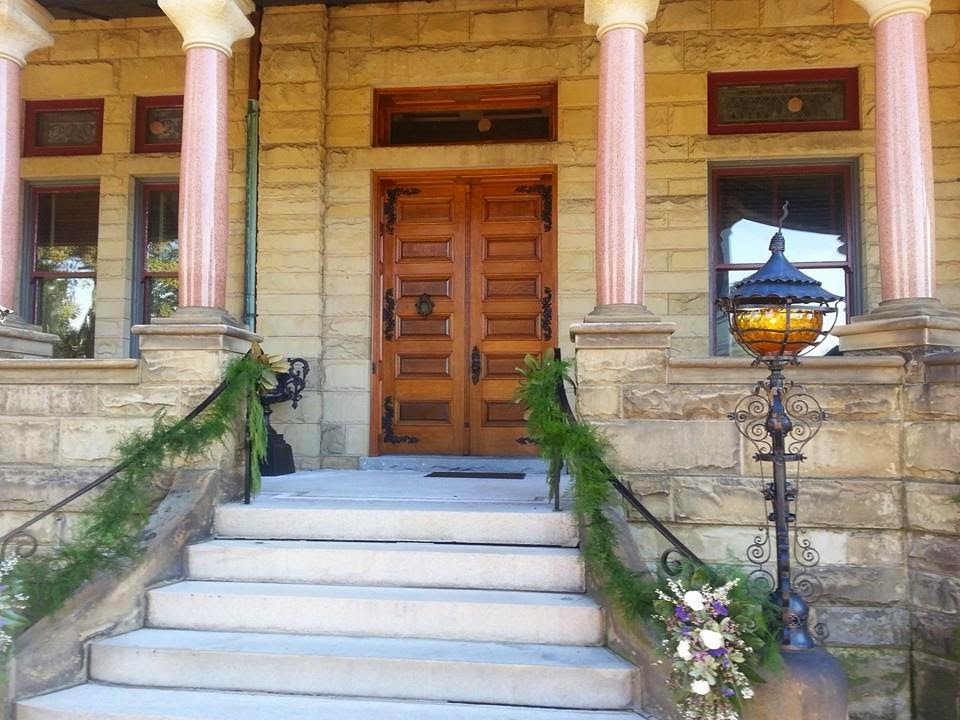
With tickets in hand, Mom and I left the basement and followed the walkway under the covered entrance to Maymont's formal entrance.  Photograph taken by Michelle L. Hamilton.

Our lovely tour guide Evelyn welcomed us into Maymont.  In the foyer the portrait of James and Sallie Dooley grace the walls of their home.  The Dooleys first viewed the land that would become their home while the couple were out riding.  Sallie Dooley became enchanted with the view and asked her husband to buy the land and to build her a home there.  James Dooley purchased the land in 1889, the next year construction began on the mansion and Maymont was completed in 1893.  James Dooley named the mansion Maymont in honor of his wife Sallie May.  Photograph taken by Michelle L. Hamilton.


James Dooley's library.  Born in Richmond on January 17, 1841 to Irish immigrants, James Dooley fought in the Civil War for the Confederacy.  After the war James Dooley became a lawyer, but would make his fortune as an industrialist.  Serving on several boards Dooley helped rebuild the war torn South.  James Dooley was a man of his times and was conservative in his politics and was aghast at the idea that women should be granted the right to vote--a sentiment that would divide his family.  Photograph taken by Michelle L. Hamilton.

Sallie Dooley's formal parlor.  Born in Lunenburg County, Virginia on July 23, 1846, Sallie May was the eighth of nine children born to an old and established Virginia family.  When she was seven years old her mother died, Sallie was then raised by her older, married sisters.  In 1869, Sallie May married James Dooley, at the time the marriage was scandalous as the bride had been raised an Episcopalian and the groom was Roman Catholic.  Writing to a family member after the ceremony, Sallie asked that the it be kept a secret that she had been married by a Catholic priest.  Photograph taken by Michelle L. Hamilton.

The formal dining room.  The Dooley's were know for their fine entertainments and this room saw many elegant dinners.  Photograph taken by Michelle L. Hamilton.

Sallie Dooley's card room on the second floor.  Maymont was at the center of Richmond high society and many parties and gatherings took place here.  Sallie Dooley was for her fine Southern hospitality.  Fond of playing cards, Sallie Dooley would invite her lady friends to an afternoon of cards in her card room where they would play the fashionable and popular game of Bridge.Photograph taken by Michelle L. Hamilton.

 The staircase lead up to the third floor where the guest rooms and some servant quarters where located.  Even though the Dooleys where childless, the couple did come from large families and their nieces and nephews where frequent guests at Maymont.  During this tour we did not visit the third floor.  Photograph taken by Michelle L. Hamilton.


Sallie Dooley's study.  On the second floor, Sallie Dooley had two private rooms to dress and relax.  In this room, Sallie would answer her correspondence and entertain close friends.  Her husband also had two rooms where he could also dress and relax.  The dress is a reproduction of 1890s fashion.  Photograph taken by Michelle L. Hamilton.

Sallie Dooley's dressing room.  The room also featured a bed that Sallie could relax on before her next event.  In James Dooley's dressing room there is also a bed.  The rooms proved difficult to photograph as I was not allowed to use my camera's flash.  Photograph taken by Michelle L. Hamilton.

James and Sallie Dooley's bathroom.  When Maymont was constructed it included ever modern convenience, gas and electricity and an elevator that connected the basement kitchen to the butler's pantry on the first floor.  Photograph taken by Michelle L. Hamilton.


The master bedroom.  Sallie Dooley loved swans and decorated her bedroom in a swan motif.  At this time swan beds where at the height of fashion.  Photographs taken by Michelle L. Hamilton.


Sallie Dooley's personalized Louis Vuitton trunk.  The Dooleys spent six months at Maymont every year, then spent the remaining time traveling and at their summer home Swannanoa.  About 40% of the items on display belonged to the Dooleys.  To learn about Swannonoa visit: http://en.wikipedia.org/wiki/Swannanoa_%28mansion%29.  Photograph taken by Michelle L. Hamilton.


Following the guided tour, Mom and I went back to the basement where there is an excellent display on the servants who served the Dooleys and kept Maymont running.  The photographs above are the restored female servant quarters.  Unlike on the TV series "Downton Abbey," few servants lived full time at Maymont.  Most lived off the estate with their family in Richmond traveling daily to Maymont.  Unlike the servants on "Downton Abbey," the servants at Maymont where not close to the Dooley's in the way that Carson and Mrs. Hughes are.James and Sallie Dooley where born into a slave owning society and their parents owned slaves.  Reconstruction and the laws of the Jim Crow South prevented any close intimacies between the Dooleys and their help.  Photographs taken by Michelle L. Hamilton.

Reproduction of the servants uniforms.  While on duty female servants had to wear their uniform, they even had to wear their uniform even when they left Maymont if they were in the company of Sallie Dooley--a practice that the ladies found degrading.  Photograph taken by Michelle L. Hamilton.

James Dooley's wine cellar.  Even during Prohibition, which came early to Virginia in 1916, James Dooley kept his wine cellar stocked at Maymont and Swannanoa.  Photograph taken by Michelle L. Hamilton.


Maymont's kitchen.  The servant display is fascinating and is supplemented with fascinating markers detailing the life of servants in Gilded Age Richmond.  Photographs taken by Michelle L. Hamilton.

Maymont is a fascinating location and I highly recommend visiting.  I will be returning, as the estate features different tours and events throughout the year.  For more information please visit: http://maymont.org/.


Sunday, January 18, 2015

Radio Show

Today I had the pleasure of talking with Royce Holleman Talknow Radio on Supernatural Live Network.  You can click on the link below to listen to today's show on Youtube!

https://www.youtube.com/watch?v=wJdqIoz4qGY

Lee Hill and Howison Hill

This afternoon I embarked on another battlefield excursion.  The rain had cleared and I had finished my radio show interview.  Since it was late in the afternoon by the time I left home with my parents and two poodles, we decided to just go to the Fredericksburg battlefield.  Instead of taking the dogs for a walk on the Sunken Road, we decided to be adventurous and visit Lee Hill--which we had not had a chance to visit yet.

Before the Battle of Fredericksburg, Lee Hill was known as Telegraph Hill.  The battle forever altered the city of Fredericksburg, and this hill was renamed Lee Hill because it was from this vantage point Gen. Robert E. Lee witnessed the battle with Gen. James Longstreet on December 13, 1862.  Photograph taken by Michelle L. Hamilton.

The hill is naturally commanding and made a perfect spot to observe the battle and place heavy artillery.  The hill is step, but the National Park Service has laid a nice, easy path to take you to the summit.  Be prepared for a twenty minute hike.  Photograph taken by Michelle L. Hamilton

A view while walking up Lee Hill.  Photograph taken by Michelle L. Hamilton.

The summit at last!  Photograph taken by Michelle L. Hamilton.


Beside using the spot for observation, Confederate forces also placed heavy artillery on the hill.  From this spot the Confederates heavily shelled Union forces as they crossed the Rappahannock River on pontoon boats.  Once the Union forces crossed and entered Fredericksburg, the Confederate artillery continued its barrage.  Union forces answered back and shelled the Confederates from their position on Stafford Heights.  Leaving the citizens of Fredericksburg stuck in the middle.  Photograph taken by Michelle L. Hamilton.

The city of Fredericksburg as viewed from Lee Hill.  Confederate pioneer's cleared the land of trees before the battle to give Confederate artillery a clear line of view.  On December 13, 1862, Gen. Lee had a panoramic view of the city and terrain.  From this vantage point Lee easily viewed Chatham Manor on Stafford Heights.  In the 150 years since the battle, the trees have grown back.  The church stepple in the middle of the photograph was there in 1862 and was used by Union forces to direct their artillery fire into Fredericksburg.  Photograph by Michelle L. Hamilton.

Two 30 pound Parrott guns were used on December 13, 1862.  Both guns had been made in Richmond at the Tredegar Iron Works.  The one positioned on Lee Hill blew up after its 39th firing showering Gen. Lee and Gen. Longstreet in gun fragments.  The event is dramatized in the 2003 movie Gods and Generals, though the scene was fictionalized as it showed the gun crew dying in the explosion--in actuality the gun crew escaped the explosion unharmed.  Photograph taken by Michelle L. Hamilton.

The explosion of the Parrott gun was not the only incident on the hill to put Lee's life in danger.  During the shelling, a Union shell buried itself into Confederate earthworks near this location where Lee was standing.  Fortunately for Lee the shell did not explode.  Photograph taken by Michelle L. Hamilton.

Confederate earthworks that protected Gen. Lee from Union shells.  Earthworks were designed to protect a standing soldier, erosion has diminished there original size.  Photograph taken by Michelle L. Hamilton.

Monument commemorating Gen. Lee's position.  It was from this position that Lee declared "It is well that war is so terrible--we should grow to fond of it."  Lee made this statement to Gen. Longstreet after watching a Confederate countercharge down the Deep Run valley on his right.     Photograph taken by Michelle L. Hamilton.

Lee Hill interpretation shelter.  The Battle of Fredericksburg would not be the only conflict to envelope Lee Hill.  On May 3, 1863, war returned during the Second Battle of Fredericksburg which was part of the Chancellorsville Campaign.  While the first battle in December 1862 had been an unmitigated disaster for the Union army, the second battle was a Union victory with Lee Hill falling into Union hands.  The disaster at the Battle of Chancellorsville, fought during the Second Battle of Fredericksburg, nuterlized the Army of the Potomac's achievements on May 3.  Photograph taken by Michelle L. Hamilton.

Getting back in the car, we followed the road and stopped at the next marker for Howison Hill.  Like Lee Hill, Howison Hill was used by Confederate artillery.  The delay of the arrival of Union pontoon boats allowed Confederate forces to hunker in.  During the Union delay, the Confederates placed heavy artillery on Howison Hill including the second 30 pound Parrott gun used during the Battle of Fredericksburg.  Photograph taken by Michelle L. Hamilton.

NPS interpretative marker shows the location of Union and Confederate artillery.  The photograph was taken in 1930s before the view was blocked by trees.  Photograph taken by Michelle L. Hamilton.

The view from Howison Hill today.  Photograph taken by Michelle L. Hamilton.

Cannon marks the spot where Confederate guns fired on December 13, 1862.  Photograph taken by Michelle L. Hamilton.

The view from Howison Hill, during the battle the trees had been cleared by Confederate pioneers--a contingent of soldiers tasked with clearing anything that blocked the vantage point of the guns.  Pioneers would also build and repair roads, dismantle enemy fortifications, among other tasks.  Photograph taken by Michelle L. Hamilton.

Earthworks surrounding the cannons.  Photograph taken by Michelle L. Hamilton.

Confederate earthworks, this part of the battlefield has some excellent examples of original Confederate earthworks.  Photograph taken by Michelle L. Hamilton.

By this time, the sun was starting to set.  Fortunately we had all just got loaded into the car before it started to rain again.  These two locations are only just a shadow of the treasures to be found on the battlefield and I am already looking forward to my return trip.